Safe Navigation of Bipedal Robots via Koopman Operator-Based Model Predictive Control
Kim et al., IROS 2026.
The Structured Techniques for Algorithmic Robotics (STAR) Lab at Georgia Tech, directed by Harish Ravichandar, develops structured computational and learning frameworks that combine classical tools with the latest advances in machine learning to make robots frugal, translucent, and self-sufficient. To this end, we identify and inject appropriate generalizable inductive biases into our algorithms, architectures, objective functions, and constraints. Our work spans applications ranging from dexterous manipulation to multi-agent coordination. We are affiliated with the Institute for Robotics and Intelligent Machines (IRIM) and the Machine Learning Center (ML@GT).
We organize our work around three complementary thrusts: structured skill learning, structured coordination, and structured adaptation. Across all three, we focus on three design principles: frugality, translucency, and self-sufficiency.
Read Harish's research statement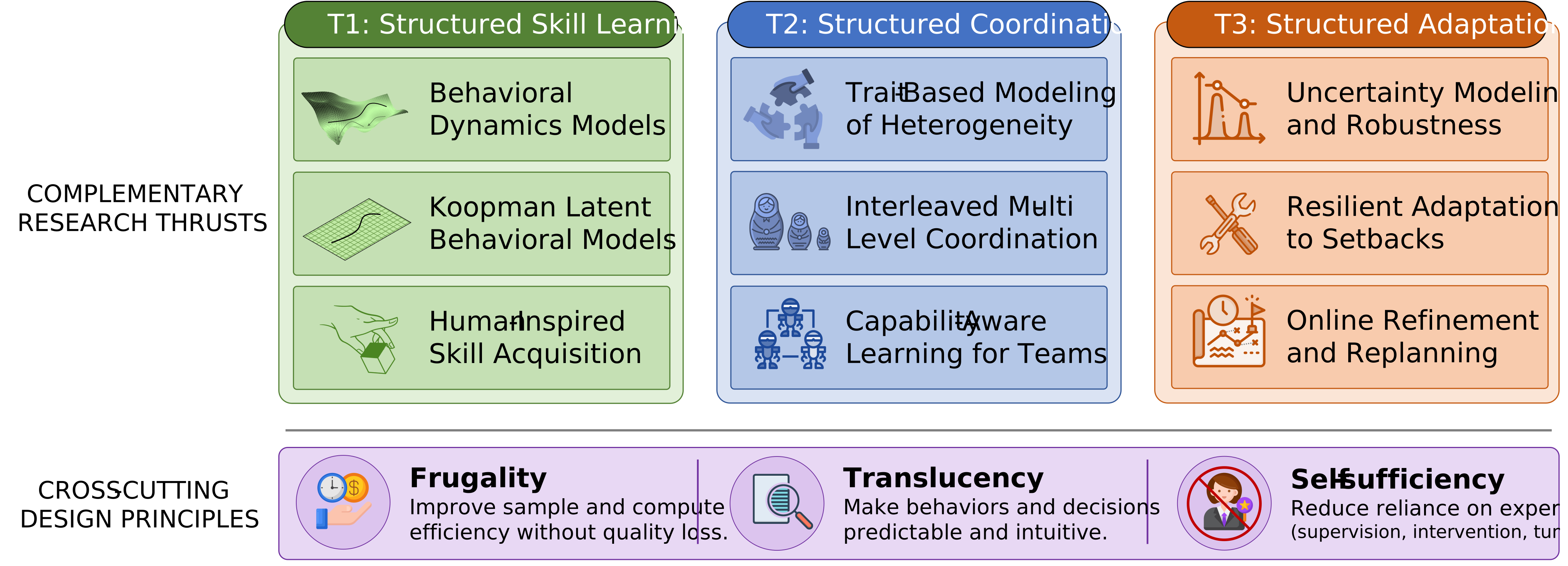
A two-minute research overview talk from 2025.
We recruit graduate and undergraduate students for projects in dexterous manipulation and multi-agent coordination. Before contacting us, please read Harish's research statement, and some of our recent papers to understand our research interests. In your message, share the specific research questions that excite you and why you want to investigate them at our lab.
Kim et al., IROS 2026.
Kailas, Jain et al., CVPR EAI 2026 (Oral).
Sathyanarayan et al., RSS 2026.
Yu, Zhang et al., CoRL 2026.